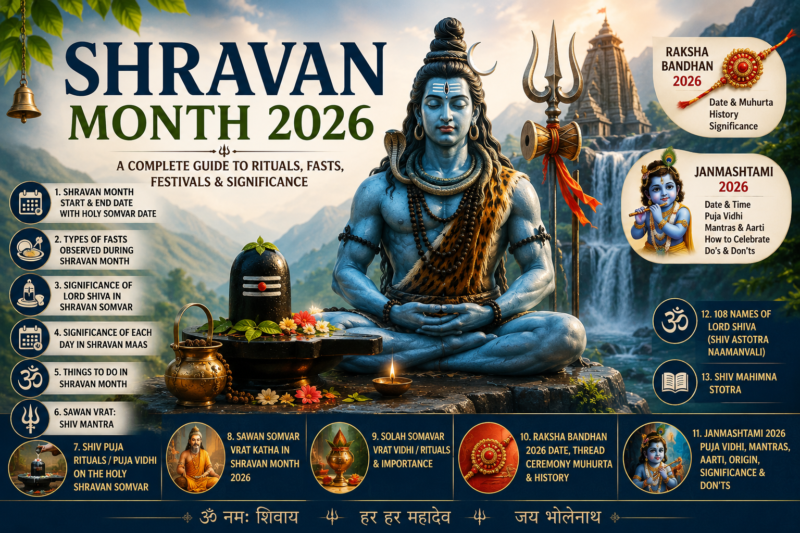
Shravan Month 2026
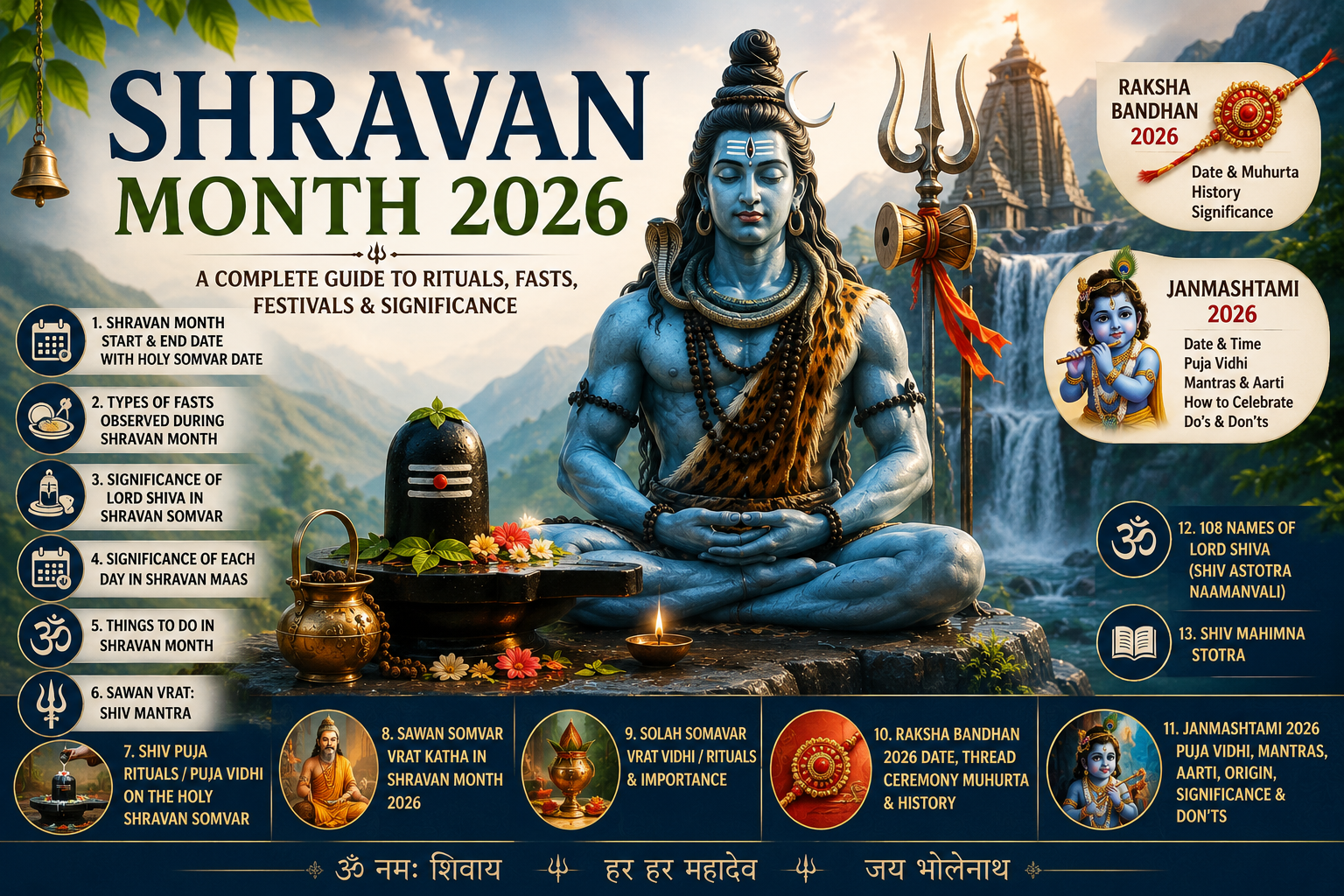
The list of festivals comes in the holy Shravan month festivals 2026 also how to celebrate and how to do puja and many more !!
1) Shravan month start & end date with holy somvar date too.
2) Types of fasts observed during the shravan month.
3) The significance of lord shiva in shravan somvar.
4) Significance of each day in shravan maas
5) Things to do in shravan month
6) Sawan vrat: Shiv mantra
7) Shiv puja rituals/puja vidhi on the holy shravan month somvar.
8) Sawan somvar vrat katha in the shravan month 2026
9) Solah somavar vrat vidhi/rituals & importace
10) Raksha bandhan 2026 date, thread ceremony muhurta & history
11) Janmashtami 2026, date and time of puja vidhi 2026, janmashtami origin | significance, how to celebrate janmashtami, mantras of pooja in janmashtami, krishna janmashtami puja vidhi with mantra, aarti of janmashtami, don’t do these things on janmashtami.
12) 108 name of lord shiva (Shiv astotra naamanvali)
13) Shiv mahimna stotra
1) In holy Shravan Month 2026 shravan month start & end date with holy somvar date too.
Shravan 2026 date: the month of sawan is dear to shiv ji, when will it start and end, know the exact date of shravan month here
Shravan 2026 date: the month of sawan is the beloved month of lord shiva shankar. bholenath fulfills all the wishes of his devotees by performing proper worship and fasting in this month. know the correct date of savan month.
the month of sawan is considered very good for worshiping lord bholenath. throughout this month, devotees perform puja on the shivling and observe fast on the monday that falls in savan. kanvar yatra is also conducted in this month.
All Tuesdays or Mangalwar in Shravan month are dedicated to Goddess Parvati, the consort of Lord Shiva. Tuesday’s fasting during Shravan month is known as Mangal Gauri Vrat. Sawan Shivaratri and Hariyali Amavasya are other auspicious days during Shravan month.
There is fifteen days difference in starting time of Shravan month depending on the followed lunar calendar in the region. In Purnimanta calendar, usually followed by North Indian states, Shravan month starts fifteen days before Amanta calendar.
Shravan Month 2026 – Shravan month 2026 dates Uk
Shravana Somwar vrat dates 2026 in UK
Shravan month start date:
Shravan begins in August 13th 2026, Thursday.
First shravan somwar vrat
17th July 2026, Monday
Second Shravan Somvar vrat
24th July 2026, Monday
Third Shravan Somwar vrat
31st August 2026, Monday
Fourth Shravan Somwar vrat
7th August 2026, Monday
Shravana adhika maas ends
10th August 2026, Thursday
Shravan Ends
2) Types of fasts observed during the Shravan month – Shravan Month 2026
- partial fasting: in partial fasting, the devotees are allowed to eat fruits and foods like Sabudana, nuts, etc. some people also keep fast during the day and eat at night.
- austere fasting: in this kind of fasting, devotees do not eat anything during the day and only consume water. they break their fast after sunset by eating a meal that does not have onion and garlic.
3) The significance of Lord Shiva in shravan somvar
Shravan Month 2026 – according to the hindu legends, in the conflict between the devas and the asuras, poison emerged from the water. lord shiva drank all the poison to rescue the human race. this incidence took place in the shravan month. due to this, lord shiva’s body temperature rose considerably. then lord shiva donned the moon on his head, which helped to lower his temperature, and all the hindu gods poured gangajal on lord shiva, which is also followed today by the devotees.
It is also said that lord indra wanted the temperature of lord shiva to drop, and hence the rains poured excessively. that soothed lord shiva and eased him. since that time, lord shiva is honored and water is poured over lord shiva during the month of sawan, especially on mondays.
4) significance of each day in shravan maas
Each day of this month carries spiritual significance.
• monday: is the day to worship lord shiva.
• Tuesday: women worship gauri for the better health of their family.
• Wednesday: is dedicated to vithala, an incarnation of lord vishnu or krishna.
• Thursdays: are for worshiping buddh and guru.
• Friday: for worshiping lakshmi and tulsi.
• Saturdays: are for saturn (shani dev). these days are also known as shravan saturdays or sampat sanivara (wealth saturdays) as one can pray for obtaining wealth.
• Sundays: are for the sun god. sun worship was common practice in the vedic period and it is followed even now. especially in shravan, every sunday the sun is worshipped.
5) Things to do in shravan maas
1. Rudra abhishek
“rudra” means the one who is terribly infuriated, which is one of the divine qualities of lord shiva who displays it while performing his cosmic dance. tandava for the annihilation of creations shiva. by the virtue of this quality, is called rudra. abhishek means a method of worship offered to the divine
For cleansing all the misgivings, sins of the worshiper
performing shiva abhishek includes the offerings of panchamrit (mix of milk honey, sugar, ghee and curd. ganga jal, ghee. bael patra (bilva leaves), dhatura and other sacred items dear to lord shiva. rudra abhishek purifies your mind and body, offers peace, fulfills your desires and enlightens your soul.
2. Fasting
During shravan maas devotees mostly undertake four types of vrats (fasts) which are sawan somwar vrat, solah somwar vrat. pradosh vrat and mangala gauri vrat
• Shravan somwar vrat – sawan somwar vrat is observed on every monday (somvar) in the month. there are mostly 4 mondays during shravan and sometimes there are 5.
• Solah somwar vrat – it is observed by young girls to find the most ideal husband. they fast for 16 consecutive mondays starting from the first monday of this month.
• Pradosh vrat – pradosh vrat is observed on the 13th day (trayodashi tithi) of both krishna paksha and shukla paksha. the thirteenth day is considered extra special for invoking and worshipping lord shiva. on this day devotees keep a strict fast and perform shiva puja during the pradosh kaal.
• Mangala gauri vrat – mangala gauri vrat is observed on tuesdays in the shravan maas. the fast is observed for happy married life and wellbeing and long life of the partner. • shani vrat – shani vrat is observed on saturdays during the shravan maas primarily for pacifying lord shani and gaining his blessings.
3. Worship of lord shiva
devotees should wake up early preferably during brahma muhurat. clean the puja altar, take a bath and wear clean clothes. purify the house with water mixed with ganges water. take sankalpa to observe the fast.
perform abhishek ritual on the shivalinga. it is believed that lord shiva is pleased even with simple offerings of wild creepers and flowers which are easily available such as aak flowers, bel leaves and datura. offer bhasma, sandal paste. lotus flowers and rudraksha beads during prayers.
one may chant the following shiva mantras using a rudraksha rosary or silently in mind. chanting may be done at specified time and with specific number of counts (108 times or multiples of it) in the morning or evening, or you may do ajapa-japa, a silent repetition of the mantra throughout the day.
6) Shravan vrat: Mantra
Shravan vrat is also part of the Shravan Month 2026 while fasting in the shravan month, several devotees chant the mantra of “om namah shivay” and mahamrityunjaya mantra to get rid of all the diseases.
you can also worship a mahamrutyunjay mantra to fend off the negativity from your life, evil, black magic, and even untimely death.
1. Panchakshri mantra
om namah shivaya
one of the most powerful mantras is to praise lord shiva. chanting om namah shivaya 108 times every day helps in developing concentration and provides divine energy.
2. Shiva gayatri mantra
om tat purushaya vidmahe, mahadevaya dhimahi, tanno rudra prachodayat regular chanting of this mantra eliminates all kinds of fear and keeps anxiety at bay.
3. Rudra mantra
om namo bhagavate rudraya.
This powerful mantra is recited to get the blessing of the merciful lord and is considered effective for the fulfillment of one’s desires.
4. Mahamrityunjaya mantra
om trayambakam yajamahe, sugandhim pustivardham, urwarukmivbandhanaan mrityormuksheey mamritaat
Hindu scriptures describe that reciting this powerful mantra 108 times, keeps the devotee free of all diseases and provides health. wealth, and vitality.
5. Mantra/prayer for aarti
Karpur gauram karunavataram, sansara saram bhujagendra haram sada vasantam hridayaaravinde, bhavam bhavani sahitam namami.
Shravan month is considered to be the most auspicious month. lord shiva is worshiped during this month, let’s devotion and take blessings from lord shiva on this holy shravan month by doing this…
* Shiv maha puran
* Shiv swaroday
* Shiv gita
* Sansar gita
* Shiv rudri puja
* Shiv rudrabhishek
Call now for any of these services: +44 079 0373 5365
7) Shiv puja rituals/puja vidhi on the holy shravan month somvar – Shravan Month 2026
Shravan Month 2026 – as per the belief, it is said that it is easy to please lord shiva among all the gods. thus, to attain his grace, perform the rituals given below. if you are going to keep fast the whole shravan month then also you can follow this ritual the whole shravan month.
– wake up early in the morning and take a bath on sawan somwar day.
– you must then visit shiv mandir or perform an authentic rudrabhishek puja in your own house with proper rituals.
– The bel leaves, datura, gangajal, and milk are important puja materials.
– Shivling is anointed with panchamrit.
– Ghee-shakkar is offered to lord shiva.
– then pray and perform the aarti.
– after puja is completed, distribute the prasad.
8) Shravan somvar vrat katha in the Shravan Month 2026
According to the skanda purana, sawan vrat katha goes like this;
once, goddess sati made a dramatic decision to go against her father to marry lord shiva. she married him but gave up her life when she witnessed shiva, her husband, being humiliated at her father’s place. she was later reincarnated as goddess parvati, the daughter of parvat raj himalaya and naina. she carried out a severe penance and tapasya all month long to make him her better half. as a consequence, she achieved her goals and came to shiva as his adored partner.
that is why many people still follow this practice, and girls observe fast for sixteen consecutive mondays (solah somvar) to get partners like lord shiva.
9) Solah somavar vrat vidhi/rituals & importance – Shravan Month 2026
what is solah somwar vrat?
unmarried people, primarily women, observe the solah somvar vrat to seek lord shiva’s blessings and pray for an ideal husband. however, married couples, who have troubled marriages, also keep the solah somwar vrat. the vrat begins on the first shravan somwar (monday) and continues till the sixteenth consecutive monday. solah somvar vrat considered Shravan Month 2026
when to begin monday fast?
Shravan Month 2026 – it is believed that monday fasting will be very fruitful if started from the first monday of shukla paksha of shravan month (june-july). four or five monday fasting can be done in a go. and as per willingness, the person can continue this fast till 16 weeks of monday starting from shukla paksha ( waxing period of the moon) of shravan month.
solah somvar vrat also can be started in the month of kartik or karthika mas. but a simple monday fast can also be started from the first monday of shukla paksha of hindi months – chaitra, baisakh, kartik, and margsheersh.
procedure to follow during solah somvar vrat :
one can ideally begin the fast on the first monday of the bright half of shravan, chaitra, vaishakha, jyeshtha, kartika, or margsheersha months of the lunar calendar and continue for the next 16 mondays he/she must take a vow of observing fast for 16 consecutive mondays with devotion and complete faith towards the almighty and not give it up carelessly in between.
Early morning routine: the vrat begins with waking up early in the morning and taking a holy bath, one should add black til-sesame seeds to this water. if possible, sprinkle ganga jal in your house to purify the atmosphere.
Solah somvar fasting worship time
worship of solah somvar fast is certain! the day of solah somvar vrat puja time begins at 04:00 pm. the same time & worship should be done every monday!
16 Monday lent worship ingredients
Flowers, punch fruits punch nuts, gems, gold, silver, dakshina, pooja utensils, misrule, yogurt, pure desi ghee, honey, ganga water, holy water, punch juice, perfume, scent roli, molly janeu, punch sweets, belpatra, dhatura, cannabis, ber, amr manjari, barley ears, tulsi dal, mandar flower, raw milk of cow, reed juice, camphor, incense, deep, cotton, malayagiri, sandalwood, makeup ingredients of shiva and mother parvati etc.
Sixteen monday fasting worship resolution method || solah somvar vrat puja sankalp vidhi
In order to start any worship or fast, one must first make a resolution. resolution is made on the first day of solah somvar vrat puja. after that, you do regular solah somvar vrat puja and fast. first take water, akshat, betel leaf, betel nut, and some coins in hand and resolve with the following mantra:
ॐ विष्णुर्विष्णुर्विष्णुः । श्री मद्भगवतो महापुरुषस्य विष्णोराज्ञया प्रवर्तमानस्यादद्य श्रीब्रह्मणो द्वितीयपरार्द्धे श्रीश्वेतवाराहकल्पे वैवस्वतमन्वन्तरेऽष्टाविंशतितमे कलियुगे प्रथमचरणे जम्बूद्वीपे भारतवर्षे भरतखण्डे आर्यावर्तान्तर्गतब्रह्मावर्तैकदेशे पुण्यप्रदेशे बौद्धावतारे वर्तमाने यथानामसंवत्सरे अमुकामने महामांगल्यप्रदे मासानाम् उत्तमे अमुकमासे अमुकपक्षे अमुकतिथौ अमुकवासरान्वितायाम् अमुकनक्षत्रे अमुकराशिस्थिते सूर्ये अमुकामुकराशिस्थितेषु चन्द्रभौमबुधगुरुशुक्रशनिषु सत्सु शुभे योगे शुभकरणे एवं गुणविशेषणविशिष्टायां शुभ पुण्यतिथौ सकलशास्त्र श्रुति स्मृति पुराणोक्त फलप्राप्तिकामः अमुकगोत्रोत्पन्नः अमुक नाम अहं अमुक कार्यसिद्धियार्थ सोलह सोमवार व्रत प्रारम्भ करिष्ये ।
solah somvar vrat puja vidhi:
on monday fasting day, after getting up in the morning and retiring from daily activities, clean clothes are worn. after this, the pooja temple or pooja place of the house is cleaned and the lamp is lit there. all the deities are meditated and anointed with water. gangajal or raw milk is offered on shivling. then flowers are offered to lord shiva. at the same time, they are also offered belpatra. this is followed by indulgence in lord shiva. in the end, aarti of lord shiva and mother parvati is performed.
Chant this mantra in fasting and worship:
you can also chant this mantra while worshiping. this will give you the infinite grace of lord bholenath.
उं शिवशंकरमीशानं द्वादशार्द्धं त्रिलोचनम्।
उमासहितं देवं शिवं आवाहयाम्यहम्॥
The puja on solah somvar is performed in the evening during the pradosh period, i.e. you should start this puja around 4 o’clock in the third noon of the day. your puja should be completed before sunset. in this way, puja is mainly considered fruitful. the man or woman performing this fast should eat only once.
It is believed that monday is the day of the moon and the controller of the moon is lord shiva, so worshiping on this day brings not only the moon but also the grace of lord shiva. there is a belief that if virgin girls perform this fast regularly, then they get a good groom and their desires are fulfilled.
mantras to chant during the day it a compulsion to read the solah somvar katha (story) every monday during puja followed by any of the above mantras :
solah somvar vrat katha
once upon a time, shri bhagwan mahadev ji came with mother parvati, wishing to live in the world of death. amravati city of vidarbha country, which was full of all pleasures, there was a very beautiful shiva temple by the king, where he started living. once parvati ji wished to play chaucer. then on the entry of the priest into the temple, mother asked who would win in this battle? so the hindu priest said that of mahadev ji. but parvati won. then he cursed the hindu priest to be a leper for the crime of lying. after many days, the apsaras of devlok, came to that temple and seeing him asked the reason. the hindu priest without hesitation told everything.
then the apsaras were consoled and told to keep fast on sixteen mondays.
on asking about the method, he also told the method as above. with this, by the grace of shiva, all the desires are fulfilled. then the apsaras went to heaven. the hindu priest lived his life free from diseases by observing a fast on mondays. a few days later, on the arrival of shiva parvati, parvati ji asked the reason for her recovery. then the brahmin narrated the whole story. then parvati ji also observed the same fast and her wish was fulfilled. his estranged son kartikeya became obedient to his mother. but kartikeya ji asked the reason for his change of mind. then parvati ji told the same story to him too. then swami kartikeya ji also observed the same fast. his wish also came true.
after asking him his friend hindu priest observed the same fast. then that hindu priest went abroad and went to a kingdom’s swayamvara. there the king had vowed that an elephant would marry a garland around whose neck he would marry his daughter. there, by the grace of shiva, the elephant put the garland around the hindu priest’s neck. the king got his daughter married to him. on asking the girl, the hindu priest told her the story. then that girl also observed the same fast and got a beautiful son. later that son also observed the same fast and got the kingdom of an old king. when the new king went to worship on monday, his wife did not go because of disbelief. on completion of the worship, akash said that rajan should leave this girl, otherwise she will be destroyed. in the end, he expelled the queen from the kingdom. that queen came to another city crying hungry and thirsty. there he met an old lady.
he found an old lady who made threads. she started working with him, but on the second day when she went out to sell the thread, suddenly there was a strong wind and all the threads flew away, then the mistress got angry and threw her out of work.
then while crying, she reached the house of a teller, the teller kept her, but on her way to the storehouse, the oil pots fell and the oil flowed out, then that teller threw her out of the house. in this way, after being removed from all the places, she reached a beautiful forest, when she grew to drink water from the pond, the pond dried up, and little water was left which was full of insects.
after drinking the same water, she sat under a tree, but immediately the leaves of that tree fell. in this way, the tree under which she passed would become devoid of leaves, just like the whole forest came to dry. seeing this, some shepherds took the queen to the priest of a shiva temple. there the queen told the whole thing at the request of the priest and after hearing the hindu priest said that you have been cursed by shiva.
when the queen requested and asked, the hindu priest told the remedy for its solution and told the method of fasting on monday. the queen completed the fast wholeheartedly and on the seventeenth monday due to the grace of shiva, the king changed his mind.
the king sent messengers to find the queen. after finding out, the king sent a call but the hindu priest said to send the king himself. the king thought about this and reached himself. reached the door with the queen and gave her place. happiness was celebrated in the whole city, the king donated a lot to the poor and, being a devotee of shiva, started fasting on 16 mondays and after enjoying all the pleasures of the world, he went to shivdham. in this way, whoever observes 16 Mondays with full devotion, he will attain supreme happiness in this world and finally attain liberation in the hereafter.
10) Raksha bandhan 2026 date, thread ceremony muhurta & history – Shravan Month 2026
Raksha Bandhan on Saturday, August 9, 2026
Raksha Bandhan Thread Ceremony Time – 04:58 PM to 10:02 PM
Duration – 05 Hours 04 Mins
Shravan Month 2026 – Raksha bandhan is considered one of the most important festivals in Hinduism. the name, raksha bandhan, translates to ‘protection bond’, which signifies the promise to protect. on this auspicious day, sisters tie ‘rakhi’ around the wrist of their brothers.
History:
It is said that the festival gained popularity after rani karnavati, the widowed queen of Chittor, sent a rakhi to Mughal emperor humayun when she was in need of his help. it is also believed that Draupadi tied rakhi to lord Krishna. for more read our separate article on Raksha bandhan.
11) Janmashtami 2026 puja muhurt date etc – Shravan Month 2026
5253rd Birth anniversary of Lord Krishna
Krishna Janmashtami on Thursday, September 3, 2026
Nishita Puja Time – 12:39 AM to 01:21 AM, Sep 04
Duration – 00 Hours 42 Mins
Dahi handi Friday, September 4, 2026
Parana as per Dharma Shastra
Parana Time – after 06:34 PM, Sep 04
On Parana Day Ashtami Tithi End Time – 07:43 PM
Alternate Parana as per Dharma Shastra
Parana Time – after 06:18 AM, Sep 04
Parana can be done on next day sunrise after Deva Puja, Visarjan etc.
Parana as per modern tradition in society
Parana Time – after 01:21 AM, Sep 04
at many places in India, Parana is done after Nishita i.e. Hindu midnight
How is Janmashtami celebrated?
The festival of janmashtami is celebrated with great pomp across the country. on this day, the beautiful makeup of lord Krishna is done and tableaux are taken out at many places. the special beauty of this festival is seen in Mathura-vrindavan, the birthplace of lord krishna. people from all over the country come here to see the beautiful sight of krishna janmashtami. there is also a tradition of swinging the child form of lord krishna on this day. on janmashtami, fast is kept for the whole day and the fast is broken after worshiping krishna at 12 o’clock in the night(more)
12) 108 Names of Lord Shiva (Shiv Ashtottara Shatanamavali)
in Sanskrit with the traditional “ॐ … नमः” format, which is chanted during Shiva Puja and Abhishek.
श्री शिव अष्टोत्तर शतनामावली (108 Names of Lord Shiva)
- ॐ शिवाय नमः।
- ॐ महेश्वराय नमः।
- ॐ शम्भवे नमः।
- ॐ पिनाकिने नमः।
- ॐ शशिशेखराय नमः।
- ॐ वामदेवाय नमः।
- ॐ विरूपाक्षाय नमः।
- ॐ कपर्दिने नमः।
- ॐ नीललोहिताय नमः।
- ॐ शंकराय नमः।
- ॐ शूलपाणये नमः।
- ॐ खट्वाङ्गिने नमः।
- ॐ विष्णुवल्लभाय नमः।
- ॐ शिपिविष्टाय नमः।
- ॐ अम्बिकानाथाय नमः।
- ॐ श्रीकण्ठाय नमः।
- ॐ भक्तवत्सलाय नमः।
- ॐ भवाय नमः।
- ॐ शर्वाय नमः।
- ॐ त्रिलोकेशाय नमः।
- ॐ शितिकण्ठाय नमः।
- ॐ शिवप्रियाय नमः।
- ॐ उग्राय नमः।
- ॐ कपालिने नमः।
- ॐ कामारये नमः।
- ॐ अन्धकासुरसूदनाय नमः।
- ॐ गंगाधराय नमः।
- ॐ ललाटाक्षाय नमः।
- ॐ कालकालाय नमः।
- ॐ कृपानिधये नमः।
- ॐ भीमाय नमः।
- ॐ परशुहस्ताय नमः।
- ॐ मृगपाणये नमः।
- ॐ जटाधराय नमः।
- ॐ कैलासवासिने नमः।
- ॐ कवचिने नमः।
- ॐ कठोराय नमः।
- ॐ त्रिपुरान्तकाय नमः।
- ॐ वृषाङ्काय नमः।
- ॐ वृषभारूढाय नमः।
- ॐ भस्मोद्धूलितविग्रहाय नमः।
- ॐ सामप्रियाय नमः।
- ॐ स्वरमयाय नमः।
- ॐ त्रयीमूर्तये नमः।
- ॐ अनीश्वराय नमः।
- ॐ सर्वज्ञाय नमः।
- ॐ परमात्मने नमः।
- ॐ सोमसूर्याग्निलोचनाय नमः।
- ॐ हविषे नमः।
- ॐ यज्ञमयाय नमः।
- ॐ सोमाय नमः।
- ॐ पंचवक्त्राय नमः।
- ॐ सदाशिवाय नमः।
- ॐ विश्वेश्वराय नमः।
- ॐ वीरभद्राय नमः।
- ॐ गणनाथाय नमः।
- ॐ प्रजापतये नमः।
- ॐ हिरण्यरेतसे नमः।
- ॐ दुर्धर्षाय नमः।
- ॐ गिरीशाय नमः।
- ॐ गिरिशाय नमः।
- ॐ अनघाय नमः।
- ॐ भुजंगभूषणाय नमः।
- ॐ भर्गाय नमः।
- ॐ गिरिधन्वने नमः।
- ॐ गिरिप्रियाय नमः।
- ॐ कृत्तिवाससे नमः।
- ॐ पुरारातये नमः।
- ॐ भगवते नमः।
- ॐ प्रमथाधिपाय नमः।
- ॐ मृत्युंजयाय नमः।
- ॐ सूक्ष्मतनवे नमः।
- ॐ जगद्व्यापिने नमः।
- ॐ जगद्गुरवे नमः।
- ॐ व्योमकेशाय नमः।
- ॐ महासेनजनकाय नमः।
- ॐ चारुविक्रमाय नमः।
- ॐ रुद्राय नमः।
- ॐ भूतपतये नमः।
- ॐ स्थाणवे नमः।
- ॐ अहिर्बुध्न्याय नमः।
- ॐ दिगम्बराय नमः।
- ॐ अष्टमूर्तये नमः।
- ॐ अनेकात्मने नमः।
- ॐ सात्त्विकाय नमः।
- ॐ शुद्धविग्रहाय नमः।
- ॐ शाश्वताय नमः।
- ॐ खण्डपरशवे नमः।
- ॐ अजाय नमः।
- ॐ पाशविमोचकाय नमः।
- ॐ मृडाय नमः।
- ॐ पशुपतये नमः।
- ॐ देवाय नमः।
- ॐ महादेवाय नमः।
- ॐ अव्ययाय नमः।
- ॐ हरये नमः।
- ॐ पूषदन्तभिदे नमः।
- ॐ अव्यग्राय नमः।
- ॐ दक्षाध्वरहराय नमः।
- ॐ हराय नमः।
- ॐ भगनेत्रभिदे नमः।
- ॐ अव्यक्ताय नमः।
- ॐ सहस्राक्षाय नमः।
- ॐ सहस्रपदे नमः।
- ॐ अपवर्गप्रदाय नमः।
- ॐ अनन्ताय नमः।
- ॐ तारकाय नमः।
- ॐ परमेश्वराय नमः।
॥ इति श्री शिव अष्टोत्तर शतनामावली सम्पूर्णम् ॥
Chanting Tip: Offer one flower, Bilva leaf, or a spoon of water while chanting each name during Shiva Abhishek or Puja. Reciting these 108 names with devotion is believed to invoke Lord Shiva’s blessings for peace, protection, prosperity, and spiritual growth.
Har Har Mahadev!
13) Shiv mahimna stotra
It’s all about Shiv mahimna stotra!!
The Shiva Mahimna Stotra is very popular among the devotees of Lord Shiva and is considered one of the best among all Stotras (or Stutis) offered to Lord Shiva. The legend about the circumstances leading to the composition of this Stotra is as follows.
The Legends behind Shiv Mahimna stotra-(Story of Pushpadanta)
A king named Chitraratha had constructed a nice garden. There were beautiful flowers in this garden. These flowers were used every day by the king to worship Lord Shiva. One day a Gandharva (Heavenly Singer in the court of Indra, the Lord of the Heaven) named Pushhpadanta being fascinated by the beautiful flowers, began to steal them, as a consequence of which king Chitraratha could not offer flowers to Lord Shiva. He tried very hard to capture the thief, but in vain, because the Gandharvas have divine power to remain invisible.
Finally, the king spread the Shiva Nirmaalya in his garden. Shiva Nirmaalya consists of the Bilva leaves, flowers, etc. which have been used in worshipping Lord Shiva. The Shiva Nirmaalya is considered holy.
The thief Pushhpadanta, not knowing this, walked on the Shiva Nirmaalya, and by that he incurred the wrath of Lord Shiva and lost the divine power of invisibility. He then designed a prayer to Lord Shiva for forgiveness. In this prayer, he has sung the greatness of the Lord.
This very prayer became well known as the ‘Shiva Mahimna Stotra’. Lord Shiva became pleased by this Stotra, and returned Pushhpadanta’s divine powers.
Benefits of Shiv Mahimna Stotra
Whoever recites the Shiv Mahimna Stotra, rejoices in the worship of Shiva.
It helps in overcoming fear.
Whoever recites this Shiv Mahimna Stotra receives the divine grace of Lord Shiva.
Whoever recites this Shiv Mahimna Stotra, all his sins are destroyed.
Shiv Mahimna stotra Lyrics and meanings:
Shiv Mahimna Stotram – (1)
mahimnah param te parama vidusho yadyasadrishi
stutir brahma dina mapitadava sannastvayi girah,
atha vacyah sarvah svamati parina mavadhi grinan
mamapyeshah stotre hara nirapavadah parikarah
Sri Pushpadanta said:
If it is unseemly to praise You when ignorant of the extent of Your greatness, then even the praises of Brahma and others are inadequate. If no one can be blamed when they praise You according to their intellectual powers, then my attempt to compose a hymn cannot be reproached. (1)
Shiv Mahimna Stotram – (2)
Atitah panthanam tava ca mahima vanmanasayor
atad vyavrttya yam cakita mabhi dhatte shrutirapi,
sa kasya stotavyah katividha gunah kasya vishayah
pade tvarvacine patati na manah kasya na vacah.
Your greatness is beyond the reach of mind and speech. Who can properly praise that which even the Vedas describe with trepidation, by means of ‘neti-neti / not this, not this’? How many qualities does He possess? By whom can He be perceived? Yet whose mind and speech do not turn to the form later taken by Him (saguna) (2)
Shiv Mahimna Stotram – (3)
Madhu sphita vacah paramam amritam nirmitavatas
tava brahman kim vag api suraguror vismaya padam,
mama tvetam vanim guna kathana punyena bhavatah
punam ityarthe’smin puramathana buddhir vyavasita.
O, Brahman(Hindu priest)! Do even Brihaspati’s praises cause wonder to You, the author of the nectar-like sweet Vedas? 0 destroyers of the three cities, the thought that by praising Your glories I shall purify my speech has prompted me to undertake this work. (3)
Shiv Mahimna Stotram –(4)
Tavaisvaryam yat taj jagadudaya raksa pralayakrit
trayivastu vyastam tisrishu guna-bhinnasu tanushu,
abhavyanam asmin varada ramaniyama ramanim
vihantum vyakrosim vidadhata ihaike jadadhiyah.
O Giver of boons! Some stupid people produce arguments–pleasing to the ignorant but in fact hateful– to refute Your Divinity, which creates, preserves, and destroys the world, which is divided into three bodies (Brahma, Vishnu, and Shiva) according to the three Gunas, and which is described in the three Vedas. (4)
Shiv Mahimna Stotram – (5)
Kimihah kimkayah sa khalu kimupaya stribhuvanam
kimadharo dhata srijati kimupadana iti ca,
atarkyaish varye tvay yanavasara duhstho hatadhiyah
kutarko’yam kamshcin mukharayati mohaya jagatah.
To fulfill what desire, assuming what form, with what instruments, support, and material do that Creator create the three worlds? This kind of futile argumentation about You whose divine nature is beyond the reach of intellect makes the perverted vociferous and brings delusion to men. (5)
Shiv Mahimna Stotram – (6)
Ajanmano lokah kimavayava vanto’pi jagatam
adhisthataram kim bhavavidhir-anadritya bhavati,
anisho va kuryad bhuvana janane kah parikaro
yato mandastvam praty-amaravara samsherata ime.
O Lord of gods! Can the worlds be without origin, though they have bodies? Is their creation possible without a creator? Who else but God can initiate the creation of the world? Because they are fools they raise doubts about Your existence. (6)
Shiv Mahimna Stotram – (7)
Trayi sankhyam yogah pasupati matam vaishnavamiti
prabhinne prasthane paramidamadah pathyamiti ca,
rucinam vaicitryad riju kutila nana pathajusham
nrinameko gamyas tvamsasi payasa marnava iva.
Different paths (to realization) arc enjoined by the three Vedas, by Sankhya, Yoga, Pashupata (Shaiva) (doctrine and Vaishnava Shastras. People follow different paths, straight or crooked, according to their temperament, depending on which they consider best, or most appropriate–and reach You alone just as rivers enter the ocean. (7)
Shiv Mahimna Stotram – (8)
Mahokshah khatvangam parashu-rajinam bhasma haninah
kapalam cetiyat tava varada tantro pakaranam,
surastam tamriddhim dadhati tu bhavad bhru pranihitam
na hi svatma ramam vishaya mriga trishna bhramayati.
O Giver of boons! A great bull, a wooden handrest, an axe, a tiger skin, ashes, serpents, a human skull and other such things–these are all You own, though simply by casting Your eyes on gods You gave them great treasures which they enjoy. Indeed one whose delight is in the Self cannot be deluded by the mirage of sense objects. (8)
Shiv Mahimna Stotram – (9)
Dhruvam kascit sarvam sakala mapara stva dhruva midam
paro dhrau vyadhrauvye jagati gadati vyasta vishaye,
samaste’pye tasmin puramathana tair vismita iva
stuvan jihremi tvam na khalu nanu dhrishta mukharata.
O Destroyer of the demon Pura, some say that the whole universe is eternal while others say that all is transitory. Others still hold that it is eternal and non-eternal — having different characteristics. Bewildered by all this, I do not feel ashamed to praise You; indeed my loquacity is an indication of my boldness. (9)
Shiv Mahimna Stotram – (10)
Tavaisvaryam yatnad yadupari virincir-hari-radhah
paricchett- um yatav anala manala skandha vapushah,
tato bhakti sraddha bhara-guru-grinad-bhyam girisha yat
svayam tasthe tabhyam tava kim anuvrittir na phalati.
O Girisha, when You took the form of a pillar of fire, Brahma trying from above and Vishnu trying from below failed to measure You. Afterwards, when they praised You with great faith and devotion, You revealed yourself to them of Your own accord; does not surrender to You bear fruit? (10)
Shiv Mahimna Stotram – (11)
Ayatnadapadya tribhuvanama-vairavya-tikaram
d- ashasyo yadbahun abhrita ranakandu paravashan,
sthirah padmasreni racita caranam bhoruhabaleh
sthiraya stvad bhaktes tripurahara visphur jitamidam.
O Destroyer of Tripura, it was because of that great devotion, which prompted him to offer his heads as lotuses to Your feet, that the ten-headed Ravana was still (More…)
The conclusion
Shravan Month 2026 -The Shravan month is the auspicious month and worshipping lord shiva. during this month with full dedication and devotion helps one to attain peace and progress spiritually. moreover, devotees receive the blessings of The omnipotent lord shiva. everyone is going through unprecedented times with the new normal. if you are also one of the struggling ones, worshipping lord shiva this holy shravan month will certainly help you overcome the challenges.